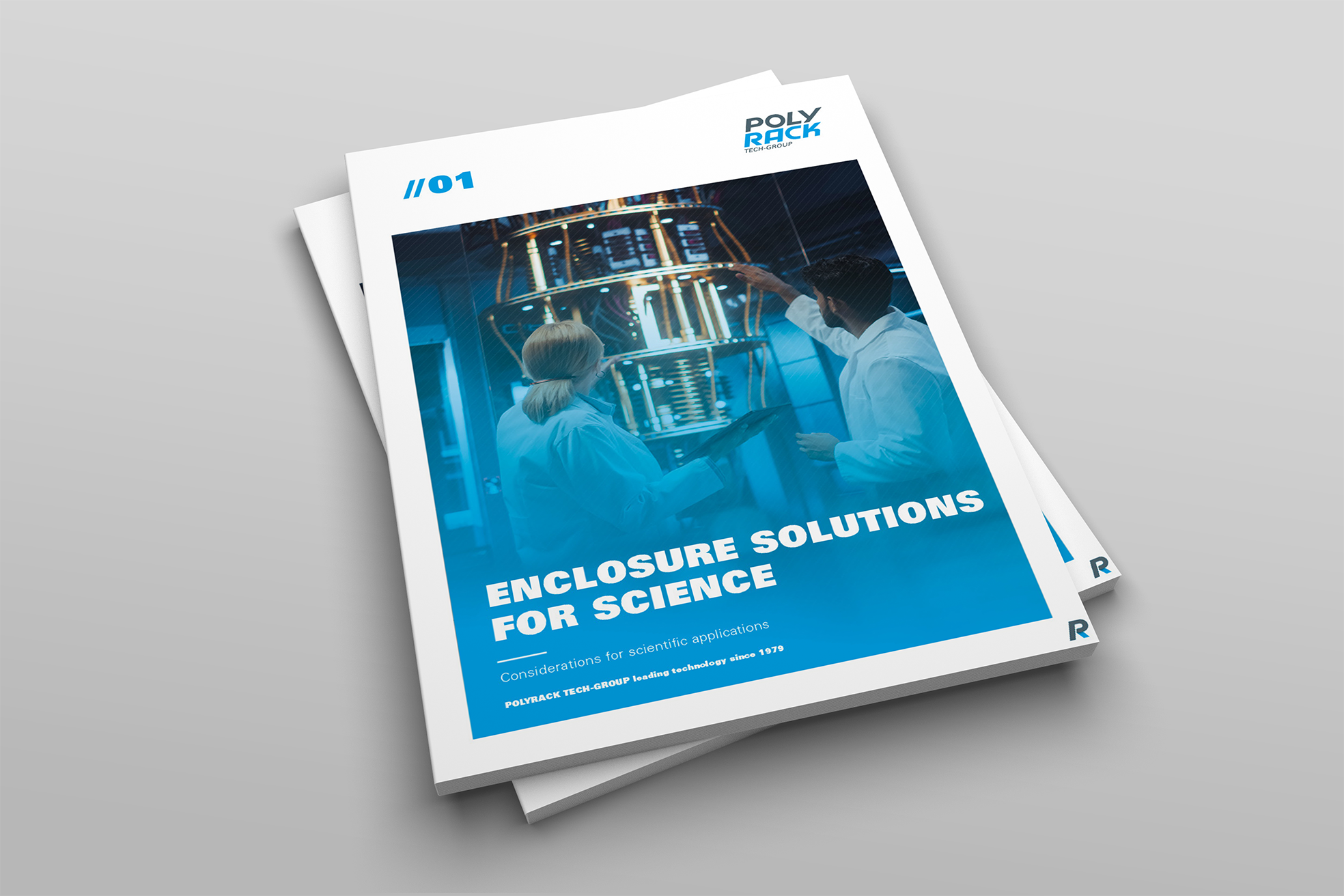
New White paper: enclosure solutions for science

Why Electronic Enclosures Matter in Modern Scientific Infrastructure
Scientific research is pushing the boundaries of technology. From particle accelerators and quantum computing laboratories to advanced AI systems and large-scale research facilities, today's scientific applications rely on increasingly powerful, complex, and sensitive electronic systems.
As computing performance increases, so do the requirements for the infrastructure supporting it. Higher power densities, faster data transmission, sensitive electronic components, and demanding operating environments present significant challenges for system designers and engineers.
This is where advanced enclosure solutions for science play a crucial role. Far more than simple protective housings, modern electronic enclosures are essential components of reliable, efficient, and future-ready scientific systems.
The Growing Importance of Electronic Enclosures in Scientific Applications
Research facilities such as CERN, the European Spallation Source (ESS), and Diamond Light Source (DLS) depend on sophisticated electronic systems for data acquisition, instrumentation, control, and processing.
These systems must deliver exceptional reliability, often operating continuously over extended periods. At the same time, scientific infrastructure must accommodate evolving technologies, upgrades, and changing research requirements.
Choosing the right electronic enclosure solution can directly influence:
- System reliability: Protecting sensitive electronics against mechanical stress, electromagnetic interference, and environmental influences.
- Thermal performance: Ensuring effective heat dissipation for high-density computing and instrumentation systems.
- Modularity and scalability: Supporting flexible configurations, maintenance, and future system upgrades.
- Electromagnetic compatibility (EMC): Minimizing interference and protecting signal integrity in sensitive scientific environments.
- Lifecycle efficiency: Reducing maintenance requirements and optimizing long-term operating costs.
A well-designed enclosure therefore contributes significantly to overall system performance and operational stability.
Four Key Application Areas for Advanced Enclosure Solutions
1. High-Energy Physics: Reliability in Complex Research Environments
Particle accelerators, detector systems, and large-scale experimental facilities require robust electronic infrastructure capable of supporting complex control and data acquisition systems.
High channel densities, demanding environmental conditions, and long equipment lifecycles make modularity, effective cooling, and EMC protection particularly important.
Modular rack-mounted enclosures and standardized electronic packaging platforms can help simplify system integration, maintenance, and future upgrades.
2. Quantum Computing: Protecting Highly Sensitive Electronics
Quantum computing introduces unique challenges for electronic enclosure design.
The control and measurement systems supporting quantum processors require exceptional signal integrity, precise instrumentation, and reliable electromagnetic shielding.
Electronic enclosures must support sensitive components while enabling flexible system configurations and efficient integration into laboratory environments.
Careful consideration of materials, shielding, thermal management, and mechanical design is essential to maintaining stable operating conditions.
3. Edge AI: Combining Computing Power with Compact Design
Artificial intelligence is increasingly moving beyond centralized data centers into industrial environments, robotics, automation, and intelligent infrastructure.
Edge AI systems process data locally, reducing dependence on remote computing resources and enabling faster responses.
However, integrating powerful computing hardware into compact enclosures creates challenges related to heat dissipation, environmental protection, and installation flexibility.
Optimized enclosure solutions help balance computing performance, physical dimensions, and operational reliability.
4. Internet of Things (IoT): Reliable Protection for Connected Devices
IoT applications rely on distributed networks of sensors, controllers, and communication devices operating in diverse environments.
Depending on the application, electronic enclosures may need to withstand dust, moisture, temperature fluctuations, vibration, or mechanical stress.
Selecting suitable materials, ingress protection ratings, and enclosure designs helps ensure dependable operation and long-term durability.
Key Considerations When Selecting Enclosure Solutions for Science
There is no universal enclosure solution that meets every scientific application. The ideal design depends on the specific technical and environmental requirements of the electronic system.
Engineers and system designers should evaluate several important factors:
- Form factor and computing platform: Selecting suitable rack-mounted, modular, or compact enclosure configurations.
- Materials and mechanical design: Balancing structural stability, weight, durability, and manufacturing costs.
- EMC protection: Ensuring electromagnetic compatibility and protecting sensitive electronic signals.
- Ingress protection: Safeguarding electronics against dust, moisture, and other environmental influences.
- Thermal management: Implementing appropriate passive or active cooling strategies.
- Cost and lifecycle considerations: Optimizing initial investment, maintainability, scalability, and long-term reliability.
Addressing these factors early in the development process can help prevent costly design changes and improve overall system performance.
From Protective Housing to Integrated System Architecture
As scientific electronics become increasingly sophisticated, enclosure design can no longer be treated as a secondary mechanical consideration.
Instead, electronic enclosures must be integrated into the overall system architecture from the earliest development stages.
A multidisciplinary approach that combines mechanical engineering, electronics, thermal management, EMC expertise, and manufacturing knowledge helps create solutions that meet both technical and economic requirements.
For scientific organizations and technology developers, selecting the right enclosure platform is an important step toward building reliable, scalable, and future-ready infrastructure.
Download Our White Paper: Electronic Enclosure Design for Advanced Scientific Applications
Are you developing electronic systems for high-energy physics, quantum computing, Edge AI, or IoT applications?
Our white paper provides valuable insights into the challenges and key considerations of modern electronic enclosure design.
Discover how packaging form factors, materials, computing platforms, EMC protection, ingress protection, thermal management, and cost considerations influence the performance and reliability of advanced electronic systems.
Download our free white paper and explore how the right enclosure strategy can support the next generation of scientific innovation.
MORE CONTRIBUTIONS
Lorem ipsum dolor sit amet, consectetur adipiscing elit.